Cold process soap explained: how it is made, whether it is good for your skin, how it differs from hot process and melt and pour, whether lye is safe, and how to read the label.
- Published
- October 12, 2026
- Reading time
- 9 min read
- Topic
- Craft & care
- Author
- Oryvane
The words cold process appear on a great many handmade soaps, usually without explanation. They describe the oldest and simplest way of making a solid bar: oils and an alkali are combined at a gentle temperature, poured into a mould, cut, and then left alone for weeks. Nothing is rushed and very little is added.
Understanding the method explains a good deal about why a handmade bar looks, feels and costs what it does. Here is how it works.
Soap is a reaction, not a mixture
You cannot make soap by stirring ingredients together, in the way you would make a cream. Soap is the product of a chemical reaction called saponification. When a fat or oil meets a strong alkali, the two react and become two new substances: soap and glycerin.
For solid bars the alkali is sodium hydroxide, traditionally known as lye. This is the part that alarms people, and it should be said plainly: there is no true soap without it. Every bar of real soap ever made, from an ancient olive oil bar to the one by your basin, began with oils and an alkali.
Is there lye in the finished bar?
No. In a correctly formulated and fully cured soap, the lye has been entirely used up by the reaction. What remains is soap, glycerin and a little spare oil. This is why ingredient lists on handmade soap can look puzzling: some makers list what went into the pot, including sodium hydroxide, while others list what came out, using names such as sodium olivate for saponified olive oil. Both describe the same bar.
Careful makers build in a margin of safety called superfatting. They use slightly more oil than the lye can convert, so that some oil is always left over. This guarantees that no free alkali remains, and it makes the bar gentler and more conditioning.
The cold-process method, step by step
| Stage | What happens | How long |
|---|---|---|
| 1. Formulating | Each oil needs a precise amount of lye. The recipe is calculated to the gram. | Before anything is weighed |
| 2. Preparing | Lye is dissolved in water or chilled milk; solid oils are gently melted. | Under an hour |
| 3. Combining | Lye solution and oils are blended until the batter thickens, a point called trace. | Minutes |
| 4. Adding | Botanicals, clays, charcoal or essential oils are stirred in. | Minutes |
| 5. Moulding | The batter is poured into moulds and kept warm while the reaction runs. | One to two days |
| 6. Cutting | The firm block is unmoulded, cut into bars and stamped. | A day |
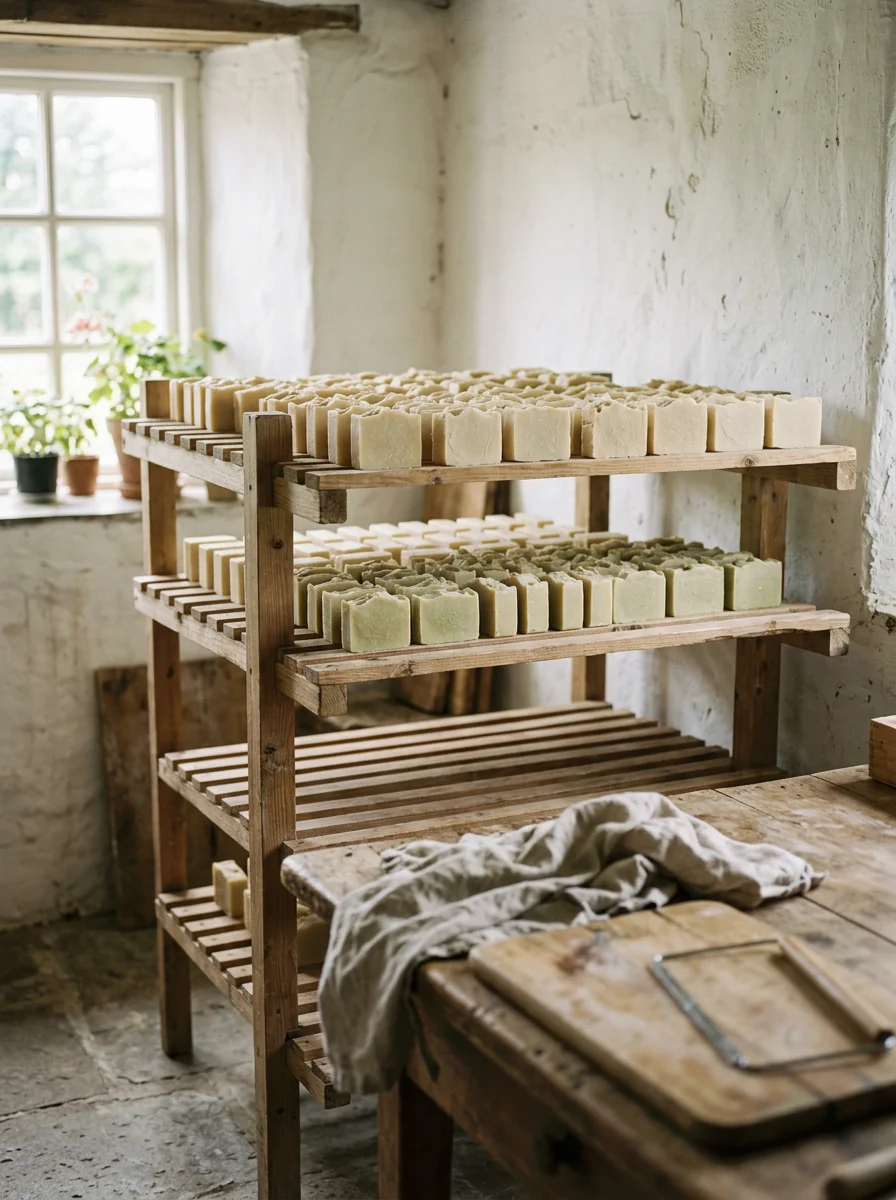
| 7. Curing | Bars rest on open racks while water evaporates and the soap matures. | Four to six weeks, often longer |
The name is slightly misleading. The process is not cold; the reaction itself gives off heat. It is called cold because no external cooking is applied, in contrast to hot-process soap, which is heated in a pot until the reaction is finished.
Why the cure matters
A bar cut from the mould is technically soap within a few days, but it is not yet a good soap. During the cure, water slowly evaporates and the internal structure of the bar settles. A cured bar is harder, lasts longer in use, lathers better and is milder on the skin than a young one.
Soaps high in olive oil benefit most from patience. They start soft and improve steadily for months, which is why the famous olive oil soaps of the Mediterranean were traditionally aged for the better part of a year. Curing takes space, racks, air and time. It is the main reason handmade soap cannot be produced overnight.
What the method keeps
- Glycerin. It forms naturally during saponification and stays in a cold-process bar. In large-scale production it is commonly separated and sold as a valuable ingredient in its own right.
- The character of the oils. Because the maker chooses and blends the oils, the bar can be tuned: olive for mildness, coconut for lather, laurel for character, milk for creaminess.
- A short ingredient list. A solid bar contains very little water, so it does not need the preservatives that liquid products require.
- Individuality. Swirls, marbling and small differences between batches are signs of the method, not flaws.
Cold process, hot process and commercial bars
| Cold process | Hot process | Typical commercial bar | |
|---|---|---|---|
| Heat | From the reaction only | Cooked in a pot | Industrial, continuous |
| Ready to use | After four to six weeks or more | Sooner, though still better cured | Immediately |
| Texture | Smooth; allows fine swirls | More rustic | Uniform, very hard |
| Glycerin | Retained | Retained | Often removed |
| Batch size | Small | Small | Very large |
It is also worth knowing that many supermarket bars are not soap at all in the technical sense, but solid blends of synthetic cleansing agents. They are perfectly legitimate products, and some are very mild, but they are a different thing from a saponified bar.
How to read a handmade soap label
- Look for the oils. Names such as olive oil, or sodium olivate, sodium cocoate and so on, tell you what the bar is built from. The first ingredient is the largest.
- Do not be alarmed by sodium hydroxide in the list. It means the maker has listed the ingredients that went in; it is not present in the finished bar.
- Check how scent is described. An essential oil named individually tells you more than the single word fragrance.
- Look for mention of curing. Makers who cure properly usually say so.
- Treat medical claims with caution. Soap cleans. A maker who claims more than that is selling something other than soap.
What it means for the bar in your hand
A cold-process bar is the result of a recipe calculated precisely, a batch made by hand, and a month or more of doing nothing at all. It will be a little softer than an industrial bar and wants a dish that drains. In return it offers a short list of ingredients you can recognise, its natural glycerin intact, and a lather shaped by oils that someone chose on purpose.
It is slow soap, in the same sense that a loaf from a good bakery is slow bread. Most of what makes it good happens while it is simply left to rest.
Is cold process soap good for your skin?
A well-formulated cold process soap is a good choice for many people. It keeps its natural glycerin, is usually superfatted with a little spare oil, and has a short list of ingredients chosen by the maker. Whether it suits you depends on the oils and additives in the particular bar and on your skin: like all true soap, it is alkaline, so very dry or reactive skin may prefer a non-soap cleanser. The method itself does not make a bar gentle; a careful recipe does.
Melt and pour: the third method
Much of the soap sold as handmade is melt and pour. The maker buys a ready-made soap base, melts it, adds colour, scent or decoration, and pours it into moulds. It is quick, safe to work with at home and allows striking designs, but the maker does not control the base recipe, and many bases contain additional ingredients to keep them clear or easy to melt. Cold process and hot process soaps are made from scratch, from oils and lye.
| Cold process | Hot process | Melt and pour | |
|---|---|---|---|
| Made from | Oils and lye, from scratch | Oils and lye, from scratch | A ready-made base |
| Maker controls the recipe | Fully | Fully | Only the additions |
| Handles lye | Yes | Yes | No |
| Cure time | Four to six weeks or more | Shorter | None |
| Look | Smooth, fine swirls possible | Rustic | Often clear or brightly coloured |
Can you make cold process soap at home?
Yes, and many people do, but it requires real care because sodium hydroxide is caustic. Home soap makers wear goggles and gloves, work in a ventilated space away from children and pets, always add lye to water rather than water to lye, weigh everything on an accurate scale, and run every recipe through a lye calculator. If you want to try, a class with an experienced maker is the safest way to start.
What about the Amish and other traditional soap?
Searchers often ask how the Amish and other traditional households make soap. Historically, home soap was made from rendered animal fat and lye, which was once leached from wood ash, using essentially the same cold or hot process described here. The chemistry has not changed; modern makers simply use precisely measured, pure ingredients and a wider choice of plant oils.
Signs of a well-made cold-process bar
- It is firm. A cured bar resists a fingernail and holds its edges in the dish.
- It does not sweat. Beads of moisture on the surface can mean too much glycerin drawn from the air or a bar that has not cured, though some humidity beads are harmless.
- It has no white crust or, if it does, it is a thin powder that rinses away. This is soda ash, harmless but a sign of how the bar was handled.
- It does not zap. Soap makers once tested bars on the tongue for a sharp tingle that indicated free lye. Do not try this; a reputable maker uses a precise calculator and pH tests instead.
- It smells of its oils and botanicals, not of rancidity. Orange spots and a stale, crayon-like smell indicate oils going off, often from an old or poorly stored bar.
- The maker tells you what is in it, how it was made and how long it cured.
None of these require expertise to notice. Pick up the bar, look at it, smell it, and read the label. A good cold-process soap gives you very little to worry about, which is, in the end, the whole point.
If a handmade bar does develop orange spots after months on a shelf, the oils have started to oxidise. It is usually still safe to use if the smell is acceptable, but it is a reminder to use natural soap within about a year and to store it somewhere cool, dark and dry.
Most of what makes a handmade bar good happens while it is simply left to rest.
Frequently asked questions
Is cold process soap good for your skin?
Often, yes: it keeps natural glycerin and is usually superfatted. It is still alkaline, so very dry or reactive skin may prefer a non-soap cleanser.
What is the difference between cold process and hot process soap?
Both use oils and lye. Hot process is cooked to completion in a pot and is ready sooner; cold process finishes in the mould from its own heat, gives a smoother bar and needs a longer cure.
What is the difference between cold process and melt and pour soap?
Cold process soap is made from scratch from oils and lye. Melt and pour starts from a ready-made base that is melted and customised.
Is lye in soap safe?
Lye is needed to make any true soap, but in a correctly made and cured bar it is fully used up by the reaction.
How can I make my own cold process soap?
With protective equipment, an accurate scale, a lye calculator and a tested recipe, ideally after taking a class. Lye is caustic and must be handled carefully.
Why does handmade soap need to cure?
Curing lets water evaporate and the soap mature, giving a harder, milder, longer-lasting bar.